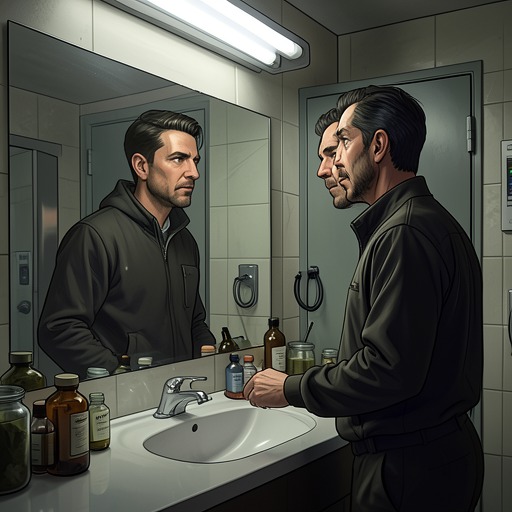
Psychiatric disorder
American PsychoPsychiatric disorder is presented as both an individual condition and a symptom of the world inhabited by Patrick Bateman. The narrative joins addiction, emotional instability, obsessive body management, sexualized risk, violent fantasy, memory failure, and reality distortion without reducing them to a single clinical label. What finally emerges is a mind that can describe its own emptiness with precision yet cannot convert confession into recognition, responsibility, or relief.
Symptoms and Social Mask
Psychiatric disorder first appears beside the elaborate routines through which Patrick Bateman maintains a socially acceptable identity. At Evelyn Richards’s apartment, after abandoning an unsuccessful attempt at sex, he finishes a tumbler of brandy and lies beside her while the Home Shopping Club displays glass dolls, embroidered throw pillows, football-shaped lamps, and Lady Zirconia in silence. Evelyn is addicted to Parnate, an antidepressant, and later asks whether Bateman uses minoxidil, making the scene a collision of medication, bodily anxiety, and consumer imagery rather than intimacy. The people around him treat chemical dependence and emotional disconnection as ordinary features of their environment, while Bateman’s own condition remains hidden behind composure and appearance.
His public persona depends on constant bodily regulation. At the gym, he moves through the Stairmaster, stretching, Nautilus machines, free weights, and resistance systems with a technical attention that turns exercise into a program of control. He notices a blemish beneath his lower lip, applies Clinique Touch-Stick, turns up his Walkman, and evaluates the bodies around him through contemptuous categories. The routine offers discipline without stability: the body is carefully constructed, but the mind remains hostile, dissociated, and increasingly unable to contain its impulses. The contrast between immaculate physical maintenance and emotional vacancy becomes one of the disorder’s most persistent outward signs.
Pathology Within the Culture of Performance
The novel repeatedly places disturbed thoughts in settings designed to signify normality. At the Yale Club, David Van Patten, Craig McDermott, and Bateman sit in carefully specified designer clothing, drink before receiving menus, plan massages, and discuss the morning episode of The Patty Winters Show about Nazis. Bateman reports being inexplicably excited by the program and even delighted when one Nazi juggles grapefruits. The disturbing response is not isolated from the social setting; it is surrounded by polished clothes, club rituals, alcohol, and the casual presence of Luis Carruthers several tables away.
At the same lunch, Bateman’s hostility toward Luis becomes a violent relational fixation. He wonders whether Courtney Lawrence would spend more time with him if Luis were dead and whether killing Luis would make his own world safer or more manageable. He weighs murder against Courtney’s attraction to his muscles and sexual body, then checks his reflection, confirms that his tan, haircut, and teeth are perfect, puts on leather Armani gloves, and approaches the stall where Luis is urinating. The sequence turns impression management into a prelude to violence: the mirror, the gloves, and the tailored clothing function as parts of a performance that does not suppress the impulse but prepares it.
The same structure governs Bateman’s treatment of Courtney. During unsafe sex, Courtney Lawrence panics about AIDS and Kaposi’s sarcoma, a promotion, a trip to Barbados, and a Norma Kamali bikini purchased at Bergdorf Goodman. Bateman responds not with care but with technical insistence about the condom’s placement and physical intimidation. Her fear is therefore absorbed into the novel’s broader pattern of medical risk, status anxiety, and bodily commodification. Disease becomes both a real danger and a social image, while Bateman’s psychiatric disorder is expressed through his inability to recognize another person’s fear except as an occasion for control.
Repetition, Media, and Emotional Numbness
Bateman’s disorder is reinforced by repetitive media consumption and by the flattening of human suffering into spectacle. During the summer, he watches videotaped disasters and repeated television images of crashing planes, wreckage, burned bodies, and rescue workers retrieving remains. He moves among restaurants, cabs, nightclubs, movie theaters, and the abandoned building in Hell’s Kitchen in a stupor, while The Patty Winters Show supplies a recurring background of sensational topics and repeats. His platinum American Express card eventually snaps in half after extensive use at a dinner with summer associates, a small material failure within a life otherwise devoted to smooth transactions.
The summer’s repetition does not soothe him. He describes life as a blank canvas, a cliche, and a soap opera, while feeling lethal and close to frenzy. His nightly bloodlust spills into daytime, and he says that his mask of sanity is beginning to slip. The need to leave New York City and go to the Hamptons follows from this escalation; Evelyn Richards accepts the suggestion. The movement from metropolitan routine to vacation is not recovery but relocation, an attempt to place mounting pathology inside another polished setting.
His attention also turns outward as contempt. At the gym, on television, at the Yale Club, and at fashionable dinners, people are reduced to bodies, brands, categories, or spectacles. The narrative’s medical language is repeatedly contaminated by social judgment: AIDS is treated as a threat to beauty and career, antidepressants coexist with luxury consumption, and psychological instability is dismissed through the same shallow vocabulary used to evaluate clothing or physical form. Psychiatric disorder is consequently inseparable from the culture that teaches its members to disguise suffering and recognize only surfaces.
Reality Failure and the Failed Confession
The most severe form of the disorder appears when Bateman’s account becomes impossible to stabilize. After a night of apparent shootings and killings, he reaches what he believes is his new office, signs in with Gus, takes an elevator upward, and calls Harold Carnes. He decides to make public what he calls his private dementia, leaving a message that admits everything and claims thirty, forty, or a hundred murders. While he speaks, he watches police cars, ambulances, flares, and a SWAT team gathering around another building, and he sobs while saying that he left a woman in a parking lot near a Dunkin' Donuts somewhere around midtown. He then identifies himself as a sick man, calls back, and leaves another message for Carnes.
The sequence makes confession unstable rather than redemptive. The apparent violence is followed by a return to office anonymity, and the surrounding world does not confirm the account in a way that resolves whether the events occurred as described. Bateman’s narration therefore becomes a psychiatric symptom and a formal problem at once: it insists on atrocity while withholding a secure external reality. The failure is not simply that others refuse to believe him; the narrative itself cannot provide a final border between action, fantasy, memory, and distorted perception.
That uncertainty returns when Bateman visits Paul Owen’s apartment. He knows he has never returned there after murdering the two girls, yet a real-estate appointment brings him back to the building. He cannot stop wondering how much the apartment is worth, hears voices behind a door whose locks have been changed, and is met by a broker who asks whether he is the eleven o’clock appointment. He answers no. The scene places alleged violence beside property value, real-estate procedure, and a new elevator operator, making the apartment’s social and commercial afterlife more tangible than any moral consequence.
Self-Definition Without Relief
At the end of the confession, Bateman describes himself as an abstraction rather than a coherent person. He says that there is no real self, only an illusory entity; that his personality is fabricated, aberrant, sketchy, and unformed; and that conscience, pity, and hope disappeared long ago, probably at Harvard, if they ever existed. He claims to have surpassed the uncontrollable, insane, vicious, and evil, while insisting that no one is safe and nothing is redeemed. The language is not an admission that produces clarity. It is a catalogue of negations in which every attempt at self-knowledge collapses into another assertion of emptiness.
Bateman further asks whether evil is something a person is or something a person does, acknowledges that his pain is constant, and states that he wants that pain inflicted on others. Yet even after admitting what he has done, he finds no catharsis and no deeper understanding. He tells Jean that his confession has meant nothing and asks how many people in the world are like him. Psychiatric disorder thus ends not in diagnosis, treatment, or transformation, but in an unanswered appeal to the surrounding society. The final disturbance is structural: the supposedly exceptional patient may be inseparable from the social order that recognizes immaculate surfaces, rewards emotional suppression, and repeatedly fails to see what lies behind them.